Around here at BeechCreek, we've been known to call reclaimed wood "history you can hammer." Designers, builders, and homeowners love it for its texture, durability, and sustainability. And once you understand where this material actually comes from and what makes it different from the fresh-cut stuff, it's hard to look at a barn beam the same way again.
What Is Reclaimed Wood?
Reclaimed wood is timber salvaged from old structures and given a second life in modern projects. Unlike new lumber milled from freshly felled trees, reclaimed wood has already done a tour of duty, holding up barn roofs, carrying loads across factory floors, or framing the walls of a 19th-century mill. That history shows in the best possible way: tighter grain, harder wood, and a texture that no amount of artificial distressing can replicate.
The distinction matters more than people realize. New-growth timber is often fast-grown, which produces a softer, more open grain. Old-growth reclaimed wood grew slowly over decades or even centuries, which makes it denser and more resistant to wear. You're not just buying something with character. You're buying something structurally superior.
Where Does Reclaimed Wood Come From?
Most reclaimed wood in the United States comes from structures that have outlived their original purpose. Here are the most common sources:
Barns and farmhouses are the backbone of the reclaimed wood supply, especially in the South and Northeast. Early 19th-century barns were built from whatever grew nearby — oak, chestnut, poplar, hickory, and pine, often hand-hewn with an axe. We source directly from old Georgia barns and mills, so the story behind every board is local and traceable.
Factories and warehouses from the industrial Northeast and Midwest contributed enormous amounts of heart pine and Douglas fir to the reclaimed market. The structural timbers in these buildings (beams, posts, joists) were built to handle serious load, which means they've aged with integrity.
Mill buildings across New England and the Mid-Atlantic are another major source, particularly for wide-plank flooring and heavy timber beams.
Other sources include old bowling alleys (maple flooring), wine barrels, boxcars, coal mines, and even sunken logs pulled from riverbeds. Each source produces wood with a different character, and experienced suppliers know which structures yield the best material.
What Wood Species Are Commonly Reclaimed?
The species you'll encounter depends largely on the region and era of the structure. Here's what shows up most often:
- White Oak and Red Oak — Among the most common, sourced from barns and buildings across the Eastern U.S. White oak is currently one of the most requested species in the reclaimed market, prized for its golden-brown tones and tight grain.
- Heart Pine — Old-growth longleaf pine, now almost impossible to source as new lumber. Heart pine from reclaimed structures is denser and more resinous than modern pine, which gives it exceptional durability.
- American Chestnut — The rarest of the common reclaimed species. Chestnut blight in the early 1900s wiped out nearly all chestnut trees in North America, so reclaimed chestnut from pre-blight barns is the only way to get it. Wormholes and color variation from honey-brown to chocolate are part of its charm.
- Hickory — Hard as nails and common in Eastern U.S. barns. Hickory scores near the top of the Janka hardness scale, which makes it particularly appealing for flooring.
- Douglas Fir — Primarily found in pre-WWII structures in the West, with a straight, even grain that machines cleanly.
- Poplar and Maple — Poplar was a workhorse in older construction; maple shows up in gym floors and bowling alleys, where decades of wear has burnished it to a natural finish.
Why Choose Reclaimed Wood? The Real Case for IT
It's more durable than new lumber
The old-growth wood in reclaimed barnwood and beams grew slowly, producing a grain density that modern fast-grown timber can't match. It's already been through decades of humidity swings, temperature changes, and structural stress, and it's still standing. That's not a feature you can manufacture.
It's genuinely sustainable
When you choose reclaimed wood, you're not just avoiding new deforestation. You're also keeping material out of landfills and using wood that has already captured and stored its carbon. New lumber production uses significantly more energy than reclaiming and remilling existing material. Some estimates put the figure at over ten times the energy. For projects pursuing LEED certification, reclaimed wood can contribute credits under both materials/resources and certified wood categories.
The look is irreplaceable
Knots, nail holes, saw marks, and weathered patina are things that manufacturers try to simulate and never quite get right. (We've seen the results. It's not the same.) Real reclaimed wood carries those marks because it earned them. Each piece is genuinely one of a kind, which is why designers and architects come back to it for statement features — mantels, beams, accent walls, and custom furniture — where "close enough" isn't good enough.
Common Uses for Reclaimed Wood
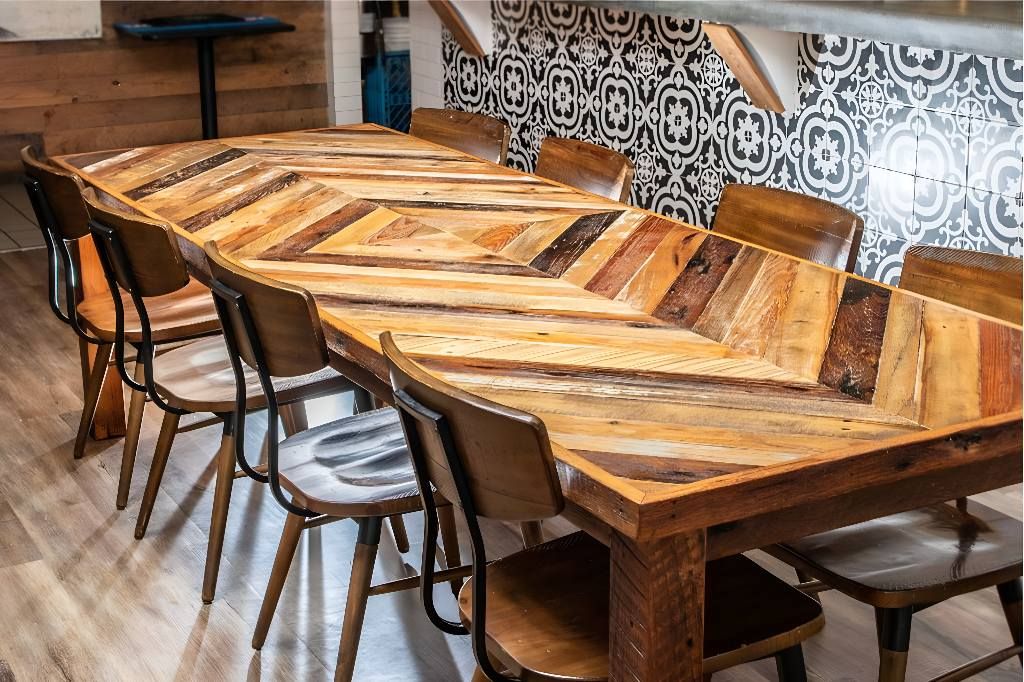
Reclaimed wood is about as versatile as building materials get. Here's where it earns its keep:
- Structural and architectural features: Ceiling beams and box beams that add visual weight without the load of a solid timber. Reclaimed wood mantels that become the anchor of a room.
- Flooring and wall panels: Wide-plank flooring in oak or heart pine. Barnwood accent walls and shiplap panels that bring warmth to contemporary spaces.
- Custom furniture: Dining tables, coffee tables, shelving, and countertops built from live-edge slabs or dimensional barnwood. These pieces don't look like they came from a catalog because they didn't.
- Outdoor features: Pergolas, planters, and benches — though outdoor use requires proper sealing and treatment to protect against moisture.
- Commercial and retail builds: Bar fronts, entry surrounds, shelving, and focal walls. Reclaimed wood is particularly popular in restaurants, where aged timber creates an atmosphere that no amount of paint can fake.
How to Spot High-Quality Reclaimed Wood
Not all reclaimed wood is the same, and knowing what separates quality material from a salvage-yard gamble saves a lot of headaches.
Kiln drying is the most important quality indicator. Proper kiln drying removes moisture, kills insects and larvae, and stabilizes the wood so it won't warp or check after installation. At our workshop, every piece goes through kiln drying before it leaves the yard. No exceptions.
Professional de-nailing and milling matters for installation. Old timber can hide broken nails, screws, and even embedded hardware. Reputable suppliers run a metal detector or magnet scan before milling. Clean edges and consistent dimensions make the difference between a smooth install and a job site nightmare.
Inspection for rot and structural weakness is non-negotiable. Not every piece from an old barn is worth keeping. Quality suppliers reject material with soft spots, deep rot, or compromised integrity, even if it looks fine on the surface.
Transparency about origin is a good sign. A supplier who can tell you which state, what structure type, and roughly what era the wood came from is a supplier who actually knows their material. At BeechCreek, we source from old Georgia barns and mills, which means we can speak to the provenance of what we sell.
Lead and asbestos testing is worth asking about, especially for wood from industrial buildings or pre-1978 structures. Reputable suppliers either test or can confirm the source is clean.
Reclaimed Wood vs. New Lumber: What's Actually Different?
| Feature | Reclaimed Wood | New Lumber |
|---|---|---|
| Grain density | Old-growth, tight grain | Fast-grown, open grain |
| Durability | Higher, already proven over decades | Lower, hasn't been tested |
| Appearance | Unique, patinated, irreplicable | Uniform, consistent |
| Sustainability | Diverts landfill waste, no new deforestation | Requires new tree harvest |
| Available species | Includes rare/extinct species such as chestnut and old-growth heart pine | Limited to commercially grown species |
| Cost | Higher upfront, lower long-term replacement cost | Lower upfront |
One thing worth flagging: some sellers market artificially distressed new lumber as "reclaimed." Real reclaimed wood has a distinct patina, nail holes, and weathering that comes from actual time and use, not a wire brush and a can of stain. When you know what to look for, the difference is obvious.
READ: Reclaimed Wood vs. New Wood: Cost, Durability, and Sustainability
Where to Buy Authentic Reclaimed Wood
Finding genuine reclaimed wood means going to suppliers who source it themselves, not just resell product of uncertain origin. BeechCreek Timber, located in Auburn, Georgia, specializes in sourcing and restoring barnwood beams, live-edge slabs, box beams, mantels, and barnwood bundles from structures across the region.
Ready to bring something with a real story into your space? Browse our products online or call us at 678-789-4577. We're happy to talk through your project, recommend the right material, and cut it to what you need.
