
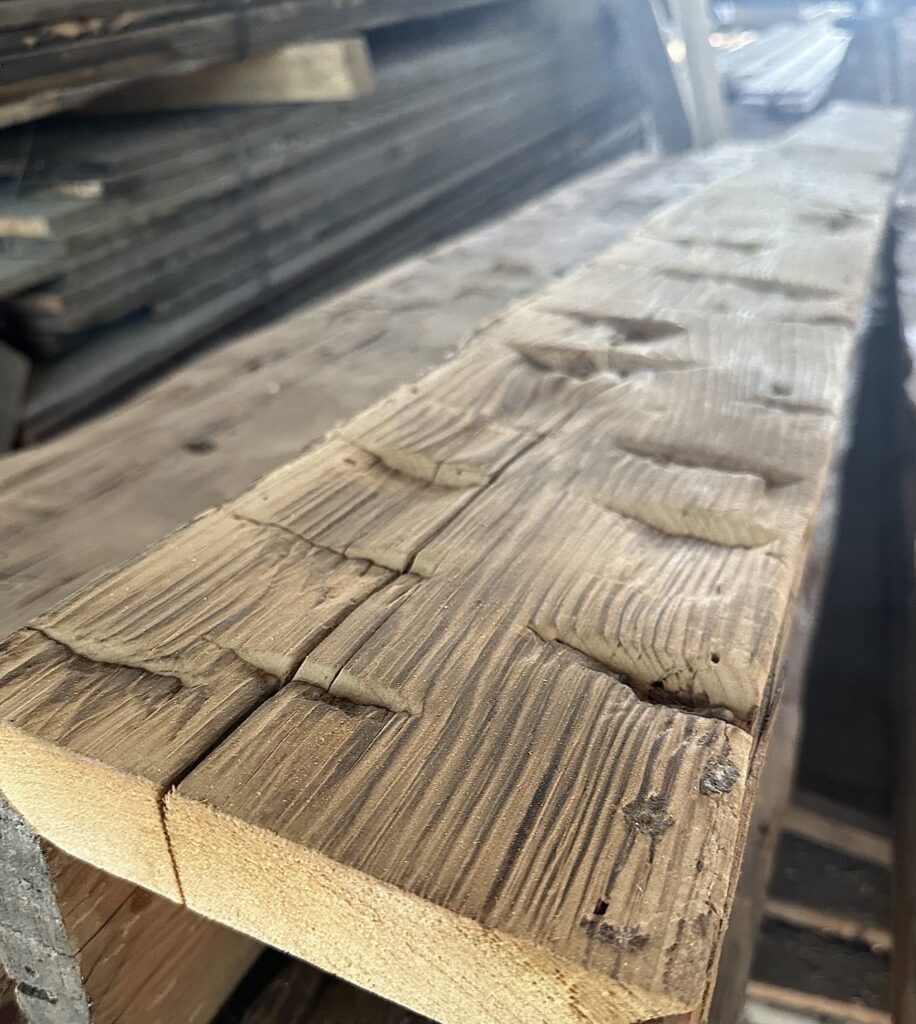
If you’re searching for faux wood beams, you probably want one thing: the look of an old barn beam across your ceiling or over your fireplace, without wrestling a solid timber into place. Most comparison articles give you two choices, foam or solid wood, and most of them are written by companies that sell foam. There’s a third option they leave out, and it’s the one most of our customers end up choosing: a real-wood box beam built from the faces of antique barn timbers.
Here’s an honest breakdown of all three, including when foam is the right call.
The Three Options People Confuse
Foam (Polyurethane) Faux Beams
Faux beams are molded from a pattern, then colored to look like wood. They’re the lightest option and purely decorative. Because the texture comes from a mold, the same knots and grain can show up on beam after beam.
Real Reclaimed Box Beams
A box beam is a hollow beam built from genuine reclaimed wood, pulled from barns that stood 60 to 200 years across Ohio, Michigan, Pennsylvania, Tennessee, Kentucky, and Indiana. We build them three-sided (open on top, against the ceiling) or four-sided. Corners are mitered, glued with Titebond III, and fastened with brad nails or trim screws, and every fastener hole is filled with sawdust and glue so it disappears into the grain. The hollow center wraps steel, LVLs, or ductwork. Box beams are decorative, not structural.
Read: What Are Box Beams & What Are They Used For?
Solid Reclaimed Beams
A solid beam is the whole timber. It’s the heaviest option, and the only one of the three that can carry load, and only when your builder or engineer designs it to.
Faux Beams vs Box Beams vs Solid Beams: Side by Side
| Foam faux beam | Real reclaimed box beam | Solid reclaimed beam | |
|---|---|---|---|
| What the face is | Molded polyurethane, colored to look like wood | Real 60–200-year-old barn wood | Real 60–200-year-old barn wood |
| Up close | Texture can repeat from beam to beam | Axe marks, saw marks, nail holes, one of a kind | Same character, plus the mass of a full timber |
| Weight | Lightest | Far lighter than solid, thanks to the hollow core | Heaviest; plan for extra hands and hardware |
| Wraps steel, LVL, or ductwork | Often, since it’s hollow | Yes, it’s built for it | No |
| Structural | No | No | Can be, when engineered |
| Length | Varies by manufacturer | Built to your size, up to 50 feet | Limited by the timbers available |
Not sure what size looks right in your room? Our wood beam size chart walks through proportions.
When Foam Is Fine
We build real wood, but foam has its place, and we’d rather tell you that than sell you a beam you didn’t need. Foam makes sense for a rental or a flip, a temporary look, or a long coffered grid high overhead where no one will ever get close. Many foam products are also sold for outdoor spots where you don’t want to maintain wood. If budget comes first and the beam lives far from eye level, foam can do the job.
When a Real Box Beam Is the Better Buy
Real wood earns its keep wherever people get close to it or look at it hard:
- Mantels and low ceilings. At arm’s length, molded texture gives itself away. Real hand-hewn faces hold up to a close look.
- Rooms you’ll photograph. Designers presenting to clients, homes going on the market, and spaces that end up on Instagram all read differently with real grain.
- Matching a mantel to ceiling beams. We can build both from the same wood, so the fireplace and the ceiling tell the same story.
- Hiding steel, an LVL, or ductwork. This is what box beams were made for. Here’s how a beam wrap works.
Every beam we ship is borate treated, and we’ll sand it on request, at no charge.
When You Actually Need a Solid Beam
If the beam has to carry weight, it has to be solid, and it has to be designed by your builder or engineer. Box beams and foam are both decorative. Solid is also the answer for a timber-frame look or a mantel that needs to be one piece of antique stock. See our solid hand-hewn beams.
How to Tell Real Hand-Hewn Wood from Foam or Distressed New Pine
Plenty of products get called “hand-hewn.” Here’s what the real thing shows:
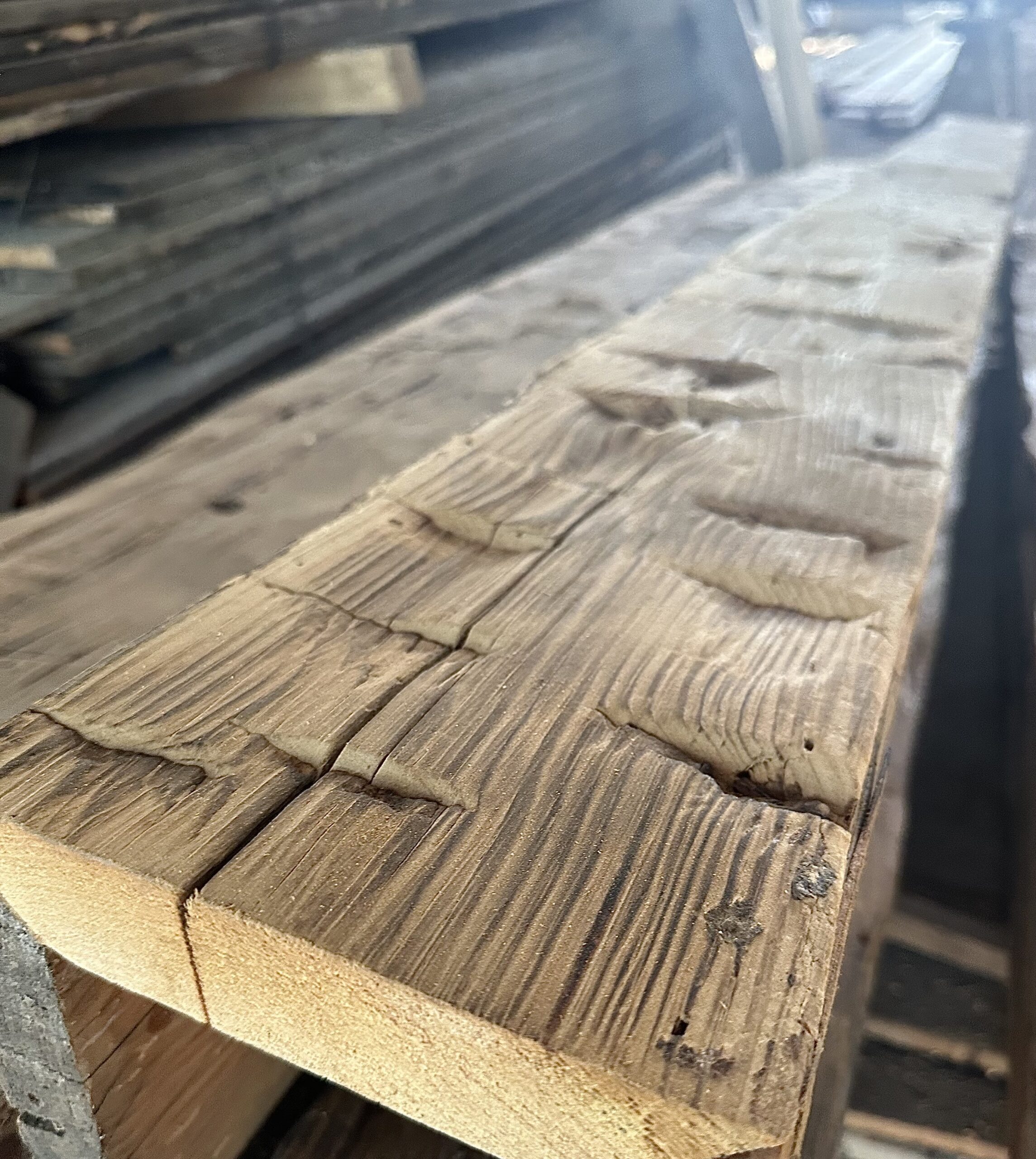
- Axe and adze marks that don’t repeat. Each swing landed a little differently. Machine distressing and molds repeat themselves.
- Worn edges. Old timbers have soft, uneven edges, not crisp machined corners.
- Marks from a working life. Old nail holes, mortise pockets, and peg holes show where a timber was joined into a barn.
- Checking. Cracks running along the grain come from generations of drying. The movement happened long ago, so the wood is seasoned and stable.
- Patina that goes deeper than paint. Real weathering is in the wood itself, not a coat on top.
The easiest test is to hold it. See our hand-hewn white oak and hand-hewn pine, or order samples and put them next to whatever else you’re considering.
Questions We Hear All the Time
Are box beams fake?
No. Every face you see is real reclaimed wood. The difference between a box beam and a solid beam is what’s inside, not what’s on the surface.
Do faux beams look real on a ceiling?
From a distance, good ones can. Up close, or when light rakes across them, repeated molded texture tends to give them away. The closer the beam sits to eye level, the more that matters.
Will a box beam wrap my existing steel beam or LVL?
Yes. Send us the interior dimensions and we’ll size the outside of the beam around them.
Box beam or solid beam for a fireplace mantel?
Both work. A box mantel is lighter to hang; a solid mantel is one piece of antique timber. See our reclaimed wood mantels and how to hang a mantel on brick.
Can I install it myself?
Many homeowners and carpenters do. We build and ship; we don’t install, and brackets are sold separately.
Do you ship?
Yes, nationwide, full length, on a hot shot trailer, tarped and strapped.
Start With a Photo of Your Room
The fastest way to know which option fits is to show us the space. Homeowners, text us a photo with rough dimensions. Designers, order samples. Builders, call 678-203-8437.
Every beam we build is made by a crew coming out of a recovery program. That’s why our shop exists, and every order keeps someone working.