
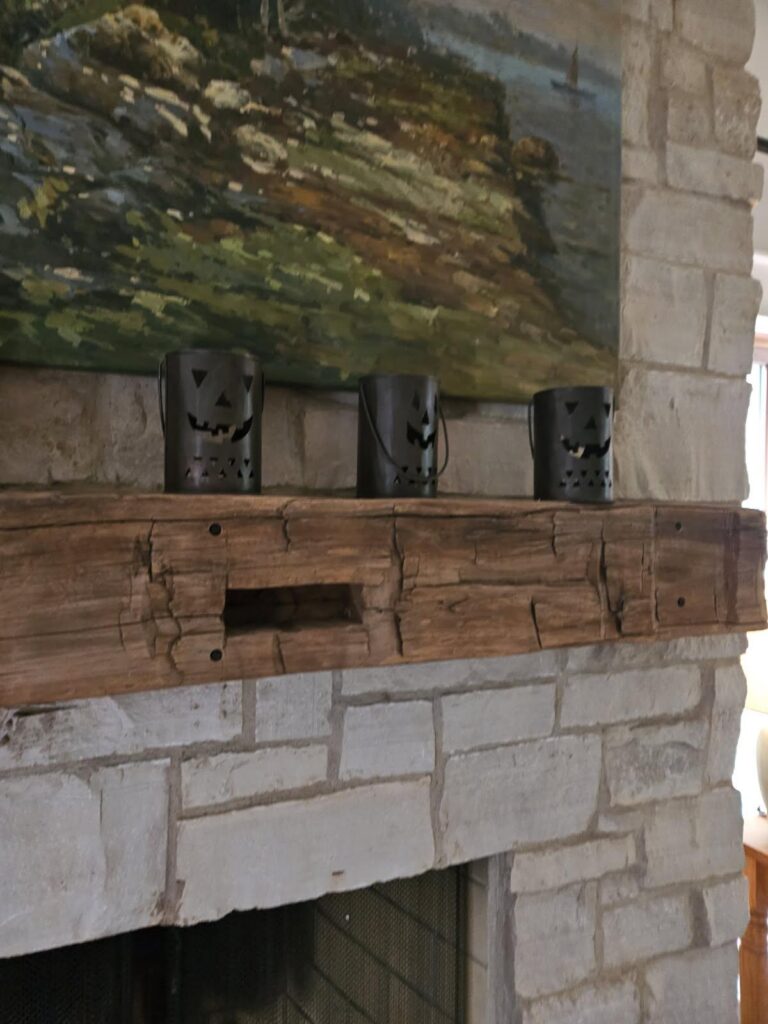
A reclaimed wood mantel is one piece of old barn timber, cut to your fireplace and set on the wall. That sounds simple, and it mostly is. But four decisions set how it looks, how it hangs and what it costs: the species and face, the size, solid versus box, and how it will be mounted. Get those right before you order and the mantel will fit the room for the next hundred years.
We cut reclaimed mantels in our shop in Auburn, Georgia, from timbers that came out of barns in Ohio, Michigan, Pennsylvania, Tennessee, Kentucky and Indiana. This guide is the conversation we have with nearly every mantel customer, written down so you can walk in ahead of it.
What a barn beam mantel actually is
Most of the “reclaimed” mantels sold online are new lumber that’s been distressed with a grinder and a chain, then stained dark. A real barn beam mantel is a section of a timber that held up a hay loft for a century or more. The difference shows up close:
- Axe marks that don’t repeat. A hand hewn face was cut by a man with a broadaxe, one stroke at a time. The marks change direction around knots and vary in depth down the length. A machine-distressed beam shows the same pattern every few inches.
- Real end grain. Look at the end of a solid mantel and you see the growth rings running all the way through. There is nothing to hide, because there is nothing hollow.
- Nail holes, mortise pockets and checks. These are the marks of the barn: where a peg went through, where a brace was let in, where the timber dried and split a little in its first decade. They are not defects. They are the reason you’re buying old wood.
- Color that goes deep. The patina on old oak or pine is not a stain on the surface. Sand into it and the wood stays warm underneath.

If a listing can’t tell you where the timber came from, assume it’s new wood.
Species and face: pick the look first
Every reclaimed timber has a species and a face, and the face matters more to the finished look than the species does.
Hand hewn is the rustic, axe-cut face most people picture when they say “barn beam mantel.” It’s the most sought-after face and the most limited, because only the outside of an old hewn timber carries it. Here’s how to spot real hand hewn wood, and the same tells apply to a mantel.
Resawn is a cleaner face. The old timber is cut on a sawmill, so you get straight saw marks and the full color and grain of the old wood without the axe texture. Resawn white oak is the pick for a transitional or modern room that wants reclaimed character without the farmhouse read.
Rough cut and weathered faces sit between those two. Rough cut shows the original mill marks; a weathered face carries the silver-grey patina of timber that saw sun and rain.
On species: white oak is our most requested wood for mantels, hands down. It’s dense, the grain is tight and the color runs from honey to deep brown. Reclaimed pine is lighter in weight and warmer in tone, with wider grain and more knots. Mixed hardwoods give you oak-like character at a lower cost, and the species varies piece to piece.
The honest advice: choose the face for the room, then the species for the color and the budget. A resawn white oak mantel will cost less than a hand hewn one, and a hand hewn pine mantel can cost less than either while still carrying the axe marks.
Sizing a mantel to your fireplace
You’ll send us three numbers: width (how far it sticks out from the wall), height (the face you see from the room) and length. Here’s how to think about each.
Length. The mantel should run past the firebox opening on both sides, and usually past the surround too, so the firebox reads as sitting under the beam rather than crowding it. Measure the width of the surround or stone, then decide how much you want the mantel to overhang each end. A longer mantel makes a fireplace look wider and lower; a shorter one makes it look taller.
Height. This is the proportion decision. A heavy stone fireplace in a room with a tall ceiling can carry a tall, thick beam. A painted brick fireplace in a standard-height room usually wants something shorter so the beam doesn’t dominate. If you’re unsure, tape a strip of cardboard to the wall at the sizes you’re considering and live with it for a day.
Width (depth). Deep enough to hold what you’ll set on it, shallow enough that it doesn’t shade the firebox or block a TV above it. Think about the actual objects: a clock, candlesticks, a framed print leaning back. The depth of a solid timber is often set by what the old beam gives us, so tell us the range you can live with.
Clearance above the firebox. Every fireplace has a minimum distance between the opening and any combustible material above it, and that number depends on your fireplace and your local code. Wood is combustible. Before you set the mantel height, check your fireplace manufacturer’s installation manual or ask your builder or inspector for the clearance that applies to your unit. We’ll cut to whatever height you give us, so get that number first.
One more thing on solid hand hewn timbers. A hewn beam was squared by hand, so an old timber is rarely a perfect rectangle. When we cut a mantel to a size that is taller than it is deep (or the other way around), one face usually has to be cut on the sawmill. We tell every customer this before we quote, and most people run that cut side against the wall or face up under the decor. Sanding and a clear finish blend it into the patina.
Solid timber or box beam mantel?
Our standard mantel is one solid piece of antique timber. That’s what the reclaimed wood mantels page describes, and for most fireplaces it’s the right answer: full weight, real end grain, no joints.
There are two cases where a hollow box beam mantel makes more sense:
- Weight. A long solid oak mantel is heavy. If it’s going on a framed wall rather than masonry, or if you want to hang it yourself without lifting help, a box beam mantel weighs a fraction of the solid one.
- Hiding something. If there’s already a beam, a ledger or a steel lintel over the fireplace, a 3-sided box beam wraps it. Here’s how a wrap works.
We build box beam mantels from boards cut off the same old timbers, mitered and glued so the corners read as one piece, and we add end caps so the ends show wood instead of a hollow. From across the room nobody can tell. Up close, a solid timber still wins on the end grain, which is why we lead with solid.
What’s included and what to ask about
Every Beechcreek mantel comes:
- Cut to your dimensions from a timber we match to the look you asked for.
- Borate treated, so any insects that rode along in the barn wood are dealt with before it enters your house.
- Unfinished. Reclaimed wood looks best with a clear finish that lets the patina show, and we’ll send stain samples if you want to go darker. You can also supply your own stain.
- Sanded on request, if you want the surface smoothed for a cleaner read or to blend a sawmill-cut face.
Ask about, or plan for:
- Brackets or corbels. Sold separately. Many mantels hang on hidden rods or a cleat with no visible bracket at all.
- Kiln drying. Old barn timber is already seasoned; the moisture left and the movement happened generations ago. We can kiln dry on request, but most mantels don’t need it.
- Shipping. Mantels ship nationwide, or you can pick up at the shop in Auburn, Georgia.
- Installation. We supply and support; we don’t install. A trim carpenter or a handy homeowner can hang a mantel in an afternoon.
How a reclaimed mantel hangs
The mounting method depends on what’s behind it:
- Brick or stone: threaded rods epoxied into the masonry, with matching holes drilled in the back of the mantel. The mantel slides on and there’s no visible hardware. Our guide to hanging a reclaimed mantel on brick walks through it step by step.
- Framed wall or drywall: a French cleat or a steel bracket lagged into the studs, hidden behind the mantel.
- Corbels or brackets: the traditional look, where the supports are part of the design. The mantel rests on them and is pinned from above.
Tell us how you plan to mount it when you order. If you’re going with rods, we can tell you how deep the mantel can be drilled; if you’re going with a box beam, we’ll make sure there’s blocking room inside.
Mantel trends we’re seeing
A few things customers are asking for right now:
- Longer and lower. Mantels that run well past the surround, mounted low enough to feel like a shelf rather than a crown.
- Resawn oak in modern rooms. Clean lines, reclaimed grain, no rustic read. It pairs with plaster, painted brick and black steel.
- Matching the ceiling. A mantel cut from the same timber family as the room’s box beams, so the fireplace and the ceiling speak the same language. If you’re planning beams too, start with the box beam styles and we’ll match the mantel.
- Floating shelves in the same wood. A pair of short reclaimed beams flanking the fireplace, built the same way as the mantel.
What to send us for a quote
You don’t need a drawing. Send:
- The look you’re after: hand hewn, resawn, weathered, or “not sure, show me.”
- Width x height x length, or the range you can live with.
- Solid or box beam, if you have a preference.
- A photo of the fireplace.
- Your zip code, for shipping.
We’ll match you to timber on the racks right now, quote it, and send wood samples so you can see the real thing on your own wall before you decide. Tell us about your project.